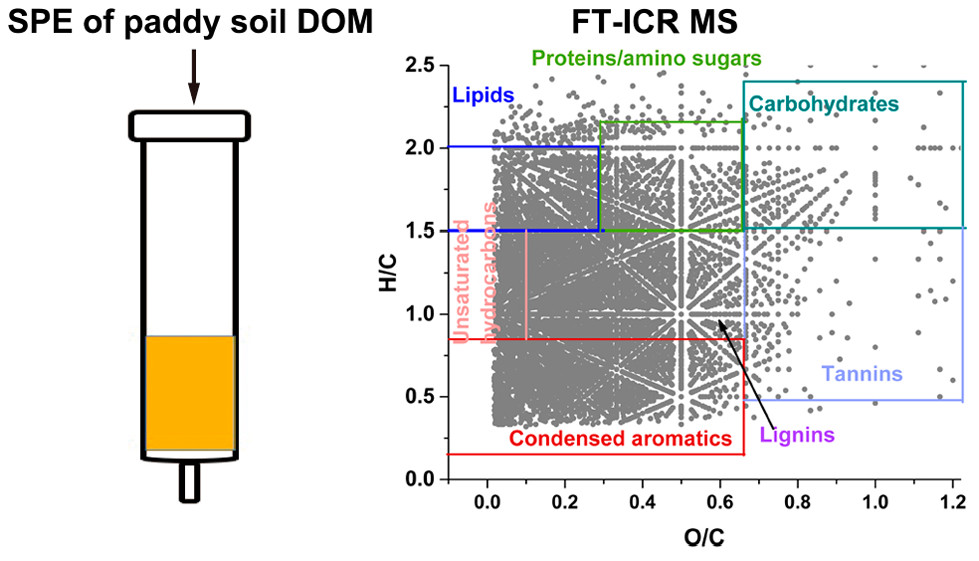


Molecular Chemodiversity of Dissolved Organic Matter in Paddy Soils
Molecular Chemodiversity of Dissolved Organic Matter in Paddy Soils
Xiao-Ming Li, Guo-Xin Sun, Song-Can Chen, Zhi Fang, Hai-Yan Yuan, Quan Shi, and Yong-Guan Zhu*
State Key Laboratory of Urban and Regional Ecology, Research Center for Eco-Environmental Sciences, Chinese Academy of Sciences, Shuangqing Road, No. 18, Haidian District, Beijing 100085, People’s Republic of China
State Key Laboratory of Heavy Oil Processing, China University of Petroleum, 18 Fuxue Road, Changping, Beijing 102249, China
Key Laboratory of Urban Environment and Health, Institute of Urban Environment, Chinese Academy of Sciences, Jimei Road, No. 1799, Jimei District, Xiamen 361021, People’s Republic of China
University of Chinese Academy of Sciences, Yuquan Road, No. 19A, Shijingshan District, Beijing 100049, People’s Republic of China
*Corresponding Authors: Yong-Guan Zhu − Email: ygzhu@rcees.ac.cn
DOI: 10.1021/acs.est.7b00377
Keywords: Aromatic compounds; Dissolved organic matter; Iron; Molecules; Soils
Abstract: Organic matter (OM), and dissolved organic matter (DOM), have a major influence upon biogeochemical processes; most significantly, the carbon cycle. To date, very few studies have examined the spatial heterogeneity of DOM in paddy soils. Thus, very little is known about the DOM molecular profiles and the key environmental factors that underpin DOM molecular chemodiversity in paddy soils. Here, Fourier-Transform Ion Cyclotron Resonance Mass Spectrometry was applied to unambiguously resolve 11361 molecular formulas in 16 paddy soils; thereby elucidating the molecular characteristics of paddy soil DOM. Soil pH, iron complexing index (Fep/FeR) and C/N ratio were established to be key factors controlling DOM profiles. Polycyclic aromatics (derived from combustion) and polyphenols (derived from plants) increased with increasing pH, while polyphenols molecules, pyrogenic aromatics, and carboxylic compounds decreased with increasing iron complexing index. Patterns in molecular profiles indicated DOM in paddy soils to become more recalcitrant at higher soil C/N ratio and higher pH. Furthermore, plant-derived polyphenols and pyrogenic DOM were retained favorably by iron and the chemodiversity of DOM in paddy soil increased with increasing soil C/N ratios. This study provides critical information about DOM characteristics at a molecular level and will inform better global management of soil carbon in paddy soil ecosystems.