
Linking the molecular composition of autochthonous dissolved organic matter to source identification for freshwater lake ecosystems by combination of optical spectroscopy and FT-ICR-MS analysis
Linking the molecular composition of autochthonous dissolved organic matter to source identification for freshwater lake ecosystems by combination of optical spectroscopy and FT-ICR-MS analysis
Shasha Liua, Zhongqi Heb, Zhi Tanga,*, Leizhen Liuc, Junwen Houa, Tingting Lia, Yahe Zhangd, Quan Shid, John P . Giesye, Fengchang Wua
aState Key Laboratory of Environment Criteria and Risk Assessment, Chinese Research Academy of Environmental Sciences, Beijing 100012, China
bUSDA-ARS Southern Regional Research Center, 1100 Robert E Lee Blvd, New Orleans, LA 70124, USA
cFaculty of Geographical Science, Beijing Normal University, Beijing 100875, China
dState Key Laboratory of Heavy Oil Processing, China University of Petroleum, 18 Fuxue Road, Changping, Beijing 102249, China
eDepartment of Biomedical and Veterinary Biosciences and Toxicology Centre, University of Saskatchewan, Saskatoon, Saskatchewan SK S7N 5B3, Canada
*Corresponding Authors: Zhi Tang − Email: tzwork@hotmail.com
DOI: 10.1016/j.scitotenv.2019.134764
Keywords: DOM; FT-ICR-MS; Optical spectroscopy; Multivariate analysis; Autochthonous sources; Lake
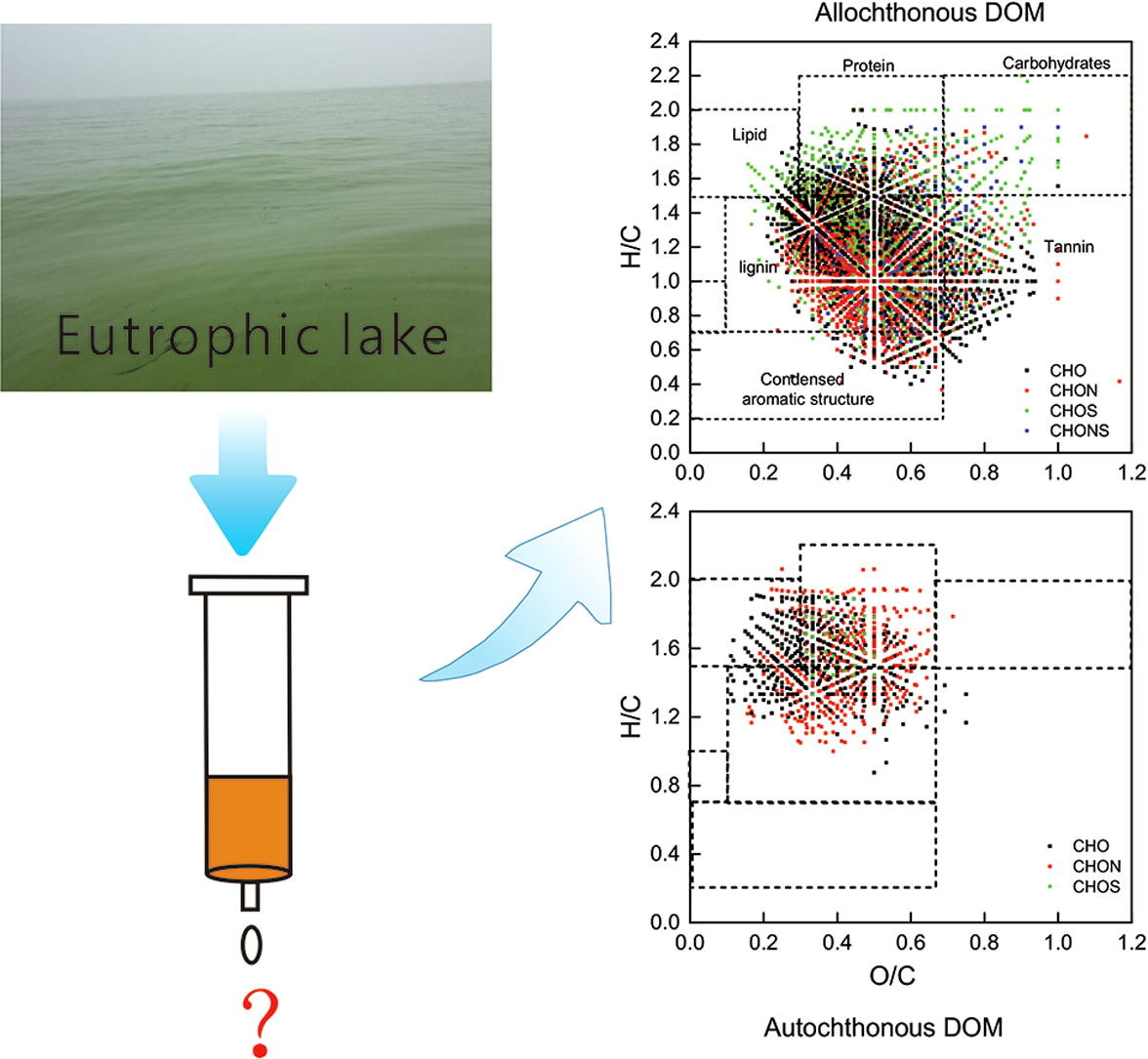
Abstract:Autochthonous dissolved organic matter (DOM) is increasingly released in lakes due to eutrophication, and thus affects the composition and environmental behaviors of DOM in eutrophic lakes. However, there are only limited studies on the molecular characteristics of autochthonous DOM and its influencing mechanisms. Herein, end-member DOM samples of macrophytes, algae, sediments and freshwater DOM samples in eutrophic lakes (Ch:Taihu and Dianchi) were collected and characterized by optical spectroscopy and Fourier transform ion cyclotron resonance mass spectrometry (FT-ICR-MS). The results revealed the chemical structures of autochthonous DOM were more aliphatic and less oxidized, which was marked by increases in lipid compounds and decreases in the lignin components as compared to the allochthonous DOM-dominated freshwaters. More specially, algae-derived DOM contains more lipid compounds, while macrophyte-derived DOM was dominated by lignin and tannin compounds according to Van Krevelen plots. Sediment-derived DOM contained more N-containing compounds. The traditional optical indices indicated the relative aromaticity covaried with polyphenolic and polycyclic aromatics, whereas those reflecting autochthonous DOM covaried with more aliphatic compounds. Multivariate analysis of FT-ICR-MS data of end-members and freshwaters revealed the predominant terrestrial input to Lake Taihu and greater contribution of algae released DOM to Dianchi. This study provides critical information about the characteristics of autochthonous DOM at a molecular level and confirmed autochthonous DOM was compositionally distinct from allochthonous DOM. Overall autochthonous DOM should be gained more attention in the eutrophic lakes.