

Molecular characterization of olefins in petroleum fractions by iodine monochloride addition and atmospheric pressure chemical ionization mass spectrometry
Molecular characterization of olefins in petroleum fractions by iodine monochloride addition and atmospheric pressure chemical ionization mass spectrometry
Shuofan Li, Ying Liu, Yahe Zhang, Jianxun Wu,Weilai Zhang, and Quan Shi*
State Key Laboratory of Heavy Oil Processing, Petroleum Molecular Engineering Center (PMEC), China University of Petroleum, Beijing 102249, People’s Republic of China
*Corresponding Author: E-mail: sq@cup.edu.cn; Tel: +86 010 89739157
DOI: 10.1021/acs.energyfuels.2c03128
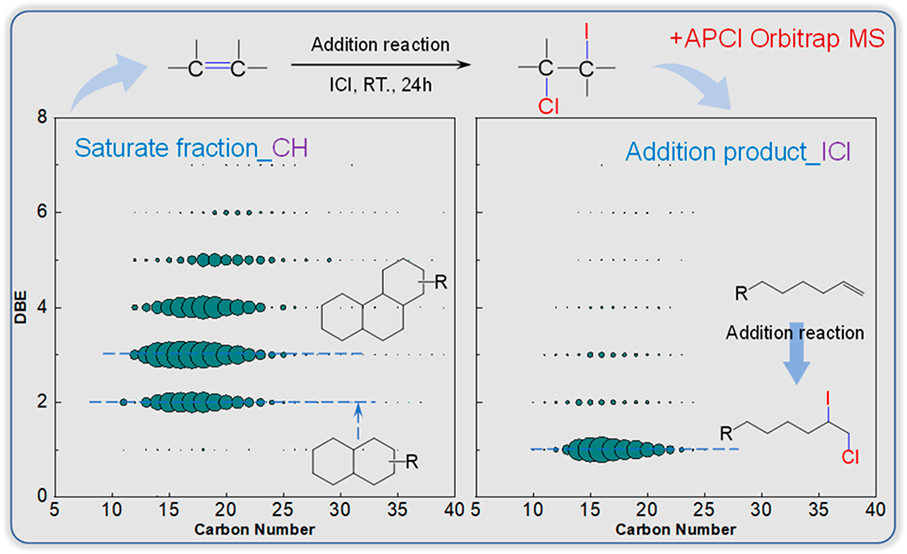
Abstact:Olefins are ubiquitous in processed petroleum streams undergoing thermal and catalytic cracking processes. However, the molecular characterization of olefins is often troublesome as a result of the presence of cycloalkanes or aromatic hydrocarbons, which cannot be distinguished from each other because of their identical molecular composition. This study provides a novel method to selectively characterize the molecular composition of olefins in processed petroleum streams. The olefins were selectively converted into halohydrocarbons with iodine monochloride as a reaction reagent and then subjected to high-resolution mass spectrometry analysis with positive-ion atmospheric pressure chemical ionization. The molecular composition of olefins in the coker diesel, the coker gas oil, and the pyrolysis gas oil was successfully characterized by the method, which indicates that the linear mono-olefins are often the dominant species. The derivatization also enables the identification of co-eluted individual compounds in gas chromatographic analysis. The method could be applicable to other streams from complex fossil fuels.