

Semiquantitative molecular characterization of crude oil
Semiquantitative molecular characterization of crude oil
Shuofan Li, Jianxun Wu* , Junyang Chen, Yunyun Li, Miao Hu, Shaokai Huang, Xujin Ren,Weilai Zhang, Yahe Zhang, Chunming Xu, and Quan Shi*
State Key Laboratory of Heavy Oil Processing, Petroleum Molecular Engineering Center (PMEC), China University of Petroleum, Beijing 102249, P. R. China
*Corresponding Authors: Jianxun Wu − Email: wjx@cup.edu.cn;Quan Shi − Email: sq@cup.edu.cn
DOI: 10.1021/acs.energyfuels.3c05086
Keywords: Aromatic compounds; Fossil fuels; Hydrocarbons; Ionization; Petrochemicals
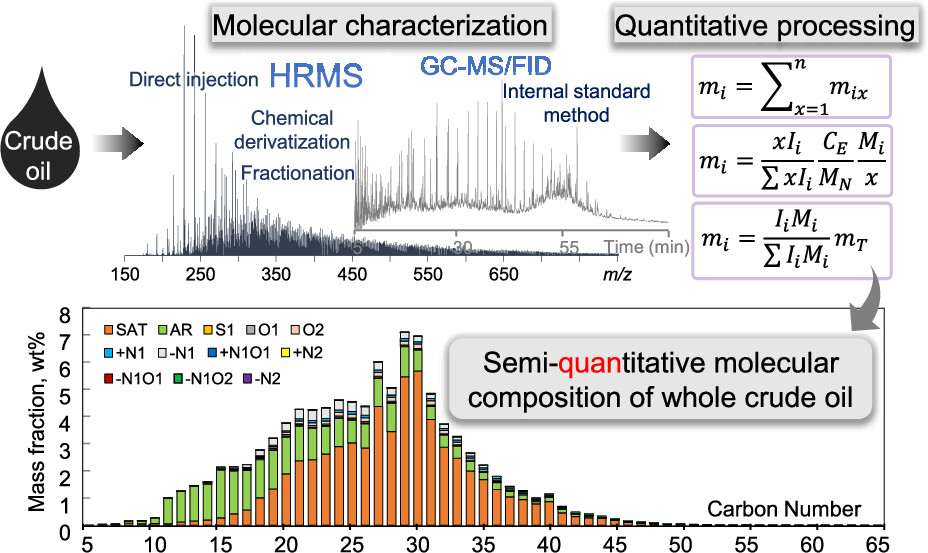
Abstract:It is an important task for “petroleomics” to realize quantitative analysis of molecular composition of crude oil. In this study, we proposed a strategy for semiquantitative characterization of whole crude oil. The molecular composition of various compounds in crude oil was selectively analyzed by using electrospray ionization high-resolution mass spectrometry combined with various chemical derivatization methods. Individual compounds in the crude oil were analyzed by gas chromatography. The results obtained from the different analysis methods were further processed and integrated based on normalization of elemental and group compositions. The quantitative results of 12 compound classes in four crude oils revealed the molecular compositional characteristics and their diversity of crude oils from multiple dimensions, including carbon number, double bond equivalent, and average molecular compositional parameters. The crude oils were further fractionated into four distillates and then subjected to semiquantitative characterization. The reliability of the semiquantified molecular composition of whole crude oil was evaluated and verified through two approaches: comparing the average molecular composition derived from both the whole crude oil and distillates and comparing the H/C ratio obtained from the semiquantitative molecular composition with that obtained by combustion elemental analysis. Although there are still some deviations in the semiquantitative molecular composition of whole crude oil, the results appear to be controllable and acceptable.